Out of all of Carter's stories in this collection,
The Lady of the House of Love is my favourite. Which is helpful for me, because you can almost always write about it in the exam.
One of the interesting things to consider, before tackling the actual story, is the
title. The title is arguably ironic considering what actually goes on in the house; innocent men are devoured due to the self-loathing nature of the Countess, the "
beautiful queen of the vampires" - that doesn't fit most people's definitions of love. Furthermore, the
preposition of 'of' (as in The Lady
of the House...) suggests that the Countess has ownership and power. Alternatively, you could argue that by being called the lady of the house she is immediately presented as a typically domestic and passive woman seen in gothic literature.
On the first page, the Countess is described as being "
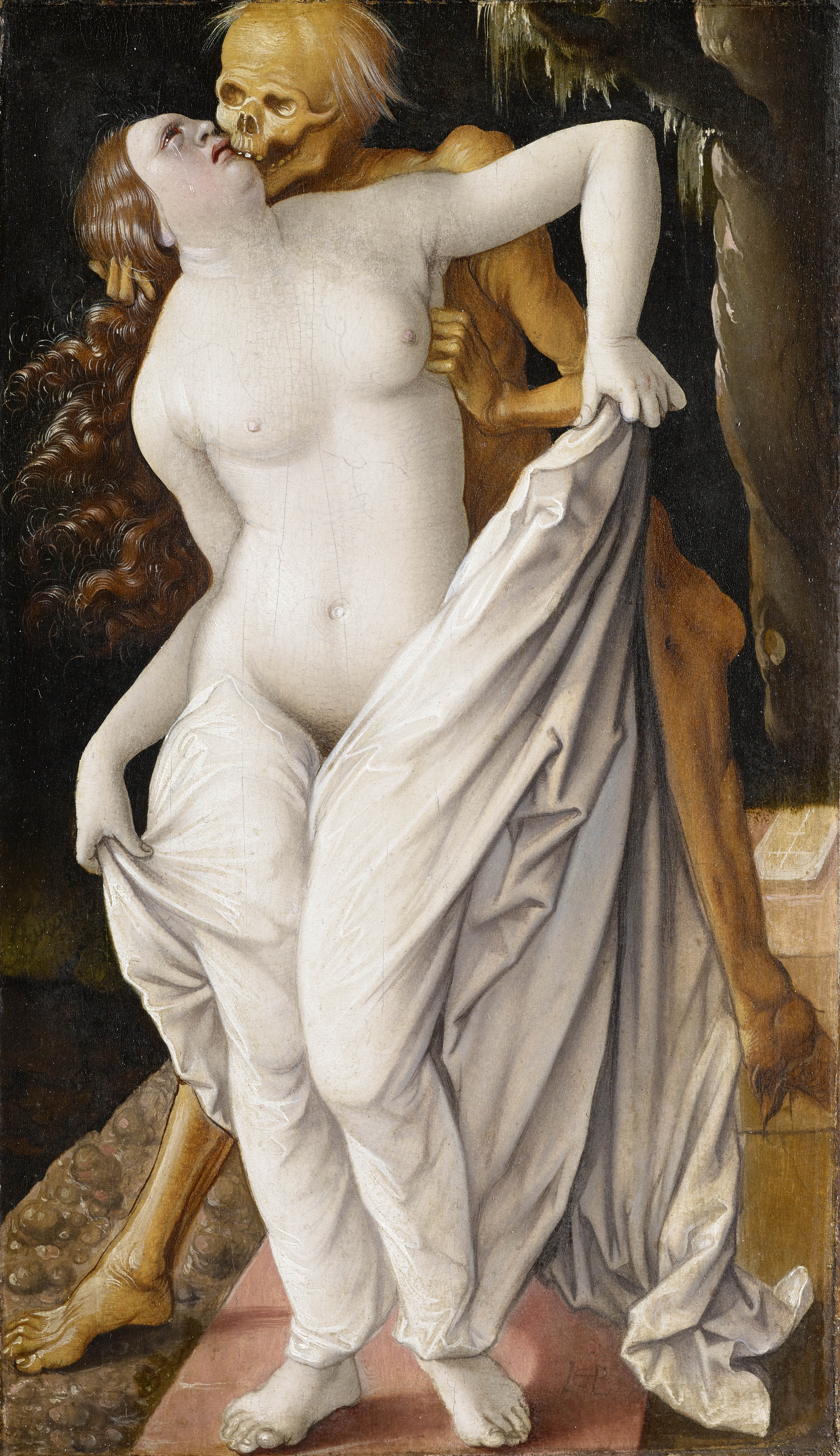
both death and the maiden". As well as being a play and a quartet, death and the maiden may link more closely to the oil painting of the same name by
Hans Baldung:
This immediately sets up the
gothic oppositions of life and death - the Countess is both alive and dead, young and old, beautiful and horrendous, at the same time. She is the predator and the prey. Being "
both death and the maiden" is also a nice use of
gothic antithesis. If you haven't noticed it already, look at the painting and laugh at how much the 'maiden' looks like Timothy Spall. That kept me entertained for ages.
One of the ways in which the Countess adheres to the typical elements of a gothic protagonist is her apparent
fascination with the past. Carter calls her actions "
her ancestral crimes", and notes that she wears "
an antique bridal gown". As well as offering the idea of a fascination with the past, the mention of marriage is also
liminal. In fact, ceremonies such as marriage are the first places whereby the word 'liminal' was actually used; when one is getting married, they are in the liminal stage between who they were when they were unmarried and who they will be when they are married.
Furthermore, the notion of a strange woman living alone in an old house wearing "
an antique bridal gown" lends to the gothic elements of
Great Expectations, and in particular the mysterious character of Miss Havisham. Below are three quotations from
Great Expectations with similar quotations from this story to enforce this particular kind of intertextuality:
Great Expectations: "
no glimpse of daylight was to be seen in it"
LotHoL: "
closely barred shutters ... keep out every leak of natural light"
Great Expectations: "
satins, and lace, and silks"
LotHoL: "
hung with black satin", "
burgundy velvet", "
red plush cloth"
Great Expectations: "
bridal flowers in her hair"
LotHoL: "
antique bridal gown"
Furthermore, time doesn't move on for either character. The links between the two appear to be more than coincidental.
Also, this story has elements of
Sleeping Beauty within it, demonstrating once again how Carter takes influence from fairy tales and extracts the "
latent content" (as she puts it) from them in order to fuse them with the gothic genre. Both Sleeping Beauty and the Countess need some kind of release and are 'trapped' in their particular situations. To be more specific, both characters are released with a kiss - it releases Sleeping Beauty from her entrapment and it releases the Countess from life. If this wasn't enough for you, Carter later says that "
a single kiss woke up the Sleeping Beauty in the Wood."
There are also
intertextual references to
Jack and the Beanstalk: "
Fee fie fo fum / I smell the blood of an Englishman." This contrasts the
allusions made to
Sleeping Beauty - the Countess is not just a trembling victim, she is also a monstrous predator. She is both the protagonist and the antagonist - this links back to the quotation about the Countess being "
both death and the maiden".
The characterisation of the Countess is particularly interesting and is great for both AO2 and AO3, because there is rich language to suggest that she is innocent and helpless (the maiden) as well as animalistic and fearsome. The fact is that she is both - which isn't a total surprise in gothic literature. She is the victim and the vixen, the predator and the prey.
The
simile "
her hair falls down like tears" presents the Countess as the typical
trembling victim archetype of gothic women, as does the fact that during the day she can be heard "
sobbing in a derelict bedroom." Later, Carter makes reference to her "
finely veined, nervously fluttering eyelids", which enforces the language used to make her seem passive and helpless. Later, she is described as "
a girl with the fragility of the skeleton of a moth" and as being "
so delicate and damned".
However, amongst this Carter manages to bring in
animalistic and monstrous imagery to make the Countess seem like a hideous beast. In a quotation that links almost directly to the wolf in
The Company of Wolves, it is noted that "
her claws and teeth have been sharpened" and that she also has "
taloned hands". Furthermore, just like a wolf, it is said that "
the Countess will sniff the air and howl." She is described as being "
all claws and teeth" and is described as being "
like a fox".
Carter also uses language to link the Countess to the
supernatural and to highlight the conflicting nature of her character. She is described as "
a closed circuit", which highlights her
self entrapment, and it is said that "
she is so beautiful she is unnatural; her beauty is an abnormality". Here Carter is tackling extremes head-on - the Countess is not just beautiful, she is so beautiful it's horrendous. This could be seen as a subversion of the typical beauty that is present in many fairy tales, particularly
Sleeping Beauty. It is asked "
How can she bear the pain of becoming human?" which of course highlights the human/monster dynamic that is common of the collection, and links to
gothic extremes,
liminality and
metamorphosis. The use of a
rhetorical question may also reflect how Carter is questioning boundaries. Another use of
gothic antithesis refers to the Countess as a "
beautiful and ghastly lady."
The Countess also keeps birds trapped in her house with her, similar to what the Erl-King does in the story of the same name. She asks the question, "
'Can a bird sing only the song it knows or can it learn a new song?'" This question is repeated twice in the story, and appears to be indicative of the Countess's situation; will she only live the life she knows how to live, or will she ever break free of it? Furthermore, it is said that she "
likes to hear it announce how it cannot escape." This presents her as a typical
femme fatale-esque character: malicious, heartless and cruel. She can't escape from her situation, so why should anything else?
The fact that the story has a fixed setting in time is also interesting, because many of Carter's stories in this collection appear time-free or time-ambiguous (which is genuinely a phrase I just made up, don't use it). Carter
modernises the gothic genre by placing her story in Eastern Europe during the First World War. By violating the fairy tale genre and placing it in a time period associated with war and death, she is sure to draw out the dark side to otherwise pleasant tales. Carter also takes the gothic genre and places it in a time of modern horror; we know that although the bicyclist survives this story, he probably won't survive for very long.
In this story, there is no young female virgin who becomes the victim of the male predator. Instead, Carter
subverts gender roles in both fairy tales and gothic literature by making the predator female and having a male virgin appear on the scene. The young bicyclist appears to represent reason and rides on a bicycle which Carter refers to as "
the product of pure reason applied to motion" and a "
two-wheeled symbol of rationality". It is the soldier's rational nature that stops him from fearing the supernatural qualities of the Countess. He is a young man on the eve of war, and he is the 'prince charming' who releases her from her self-loathing state. It is as though the bicyclist is bringing the 20th Century to the Countess, who is referred to as "
the timeless Gothic eternity of the vampires, for whom all is as it has always been and will be, whose cards always fall in the same pattern." The soldier brings her out of this timeless state - just another example of how Carter is bringing the gothic genre forwards into the modern world.
Through the soldier's eyes, we really do see everything rationally. He observes the Countess as "
a great, ingenious piece of clockwork".
Furthermore, Carter pays particular attention to virginity again (surprise, surprise) by stating that the soldier "
has the special quality of virginity". His virginity is also referred to as a "
pentacle", a word which is also used to describe the girl's virginity in
The Company of Wolves; once again it suggests a mystical power to the
liminal state of virginity. And like the protagonist in
The Company of Wolves, the soldier is logical and not afraid of the supernatural. The line "
laughing, he sets out on his adventure" links to the moment in
The Company of Wolves where the girl laughs in the wolf's face.
An interesting thing to consider regarding the soldier is whether he is presented as a masculine hero or a feminine character. He is described as "
blond" and "
blue-eyed", which are used to describe both typically heroic men and typically passive women. He is also associated with virginity, which in this collection is often more associated with woman. Yet he is also rational and logical, which is typically (unfairly, yes, but typically) associated with masculinity.
As the soldier walks towards the Countess's house, Carter uses overbearing
sensory description which links the Countess to the Marquis in
The Bloody Chamber: "
A great, intoxicated surge of the heavy scent of roses blew into his face", "
Too many roses...". Flowers are mentioned throughout the story, and at one point Carter talks of the Countess's "
red lips like the obese roses". Roses are also what have "
grown up into a huge, spiked wall" around the Countess's castle, and appears to be what traps her inside. Roses are usually
symbols of love and/or beauty, yet here Carter violates that symbol, just as the Countess's beauty is violated into a "
deformity".
When the soldier enters the house, we learn a little more about the setting and we are made aware of how gothic it is. The soldier sees his bicycle disappear into "
the dark entrails of the mansion"; by using such language, which links to dismemberment, the place is given a horrific and gory feel, as though the Countess will prey upon him as she does the other men. Carter also notes the "
lightless, cavernous interior of the place" and refers to it as "
dismal" and "
ruinous". It is also noted how "
the painted eyes of family portraits briefly flickered as they passed", a typical gothic trope also used in
The Bloody Chamber to suggest that in gothic literature the protagonist is always being watched, as though he/she cannot possibly escape. The Countess is also referred to as part of the setting: "
she herself is a haunted house." This links to how the Erl-King is both the antagonist and the setting - another example of blurring boundaries.
In the bedroom, Carter once again uses role reversal when the bicyclist kisses the Countess's wound "
as her mother ... would have done". This can be linked to the role reversal in The Erl-King, where the protagonist is referred to as "
mother" once she has killed the titular character.
Before she dies, after being released into death by the soldier's kiss, Carter changes
tense and we hear the Countess's perspective: "
the dark, fanged rose I plucked from between my thighs". Once again
rose imagery is violated and even 'fanged' as though it is as vampiric as the Countess herself.
The rational bicyclist appears to 'triumph' in the story, although really the Countess was never a true predator because she was a victim of her own nature. Rationality beats the supernatural, and "
the boy in the fairy tale" aims to "
turn her into the lovely girl she is; I will cure her of all these nightmares."
So it seems the heroic soldier has a somewhat happy ending. He releases the Countess from the tortures of life and the final line is "
next day, his regiment embarked for France." But really this isn't a happy ending at all, as the young man is about to face an even greater horror that is simply part of our history - the Great War. Is Carter suggesting that, no matter how horrific vampires and spooky houses may be, nothing in gothic literature can live up to the insurmountable horror of war?