Sunday, 2 June 2013

A2 English Literature: Education and Texts in Wuthering Heights

Throughout Wuthering Heights, texts are referenced frequently - they may serve as part of the narrative structure, they may be an important plot device and, more often than not, they link to power and oppression.

In the opening chapters, we, like Lockwood, don't really know what's going on. He keeps mistaking people for people's wives and daughters and it's all getting a bit awkward. So when he retires to bed, and stumbles upon Catherine's diary, which he refers to as "a Testament". Although this suggests that Catherine has written her diary in the blank margins of several books (which was typical at the time of writing, since paper was so expensive), it could also have symbolic meaning. By having Catherine's story written in Holy Scripture, what are we told about her 'story'? Are she and Heathcliff Adam and Eve, who "are going to rebel" against the natural order of things?

More importantly, though, the diary serves as a narrative device that lets us a) overcome some of the confusion of the preceding scenes and b) give us insight into Catherine's character.

The Bible is also associated with Joseph and Heathcliff. The association with Joseph is easy - he's your typical God-fearing character who appears bitter and callous throughout the entirety of the novel. At one point, Heathcliff's dogs are referred to as "possessed swine". This is a direct quotation from the Bible, and highlights Heathcliff as a demonic figure. Furthermore, it is interesting to note that throughout the novel, Joseph is subservient to Heathcliff. Considering Heathcliff is associated with the devil, what does this say about Joseph? Is he the devil's accomplice, even though he appears to represent religion?

When Heathcliff and Isabella get married, we are given insight into Isabella's life through her letters to Nelly. This epistolary technique allows for many things. Firstly, it gives us insight into Isabella's isolated nature; the fact that she writes to Nelly, a servant, noting "the only choice left me is you", shows that she really has hit rock-bottom as a 'respectable lady', since she is having to write to a servant.

It also gives us an insight into Isabella's life without Nelly having to be present in the action itself. Also, Isabella gives us some great language that can be used for describing Heathcliff: "Is Mr. Heathcliff a man? If so, is he mad? And if not, is he a devil?" As well as some great language about the setting of Wuthering Heights: "an ancient castle", "a dingy, untidy hole" and "I remained in the dark."

Then, later on in the novel, we understand the 'passion' between Cathy and Linton when we learn that they have been sending letters to one another. The use of letters here is interesting in two ways. Firstly, it suggests that Heathcliff is at least partially dictating Linton's letters ("touches, here and there, which I thought were borrowed from a more experienced source" - or you could argue that this refers to literature and not Heathcliff), which suggests that texts and power go hand in hand with Heathcliff. Secondly, it gives Nelly an active role in the novel - she becomes a participator as opposed to an observer when she burns the letters in the fire.

Cathy uses texts and education for power when she secretly leaves Thrushcross Grange to visit Wuthering Heights. She notes that "I gave Michael books and pictures to prepare Minny every evening" as well as "he offered, if I would lend him books out of the library, to do what I wished". By using books to more or less bribe her way into getting what she wants, Cathy is effectively using literacy/education as power. Also in this chapter, Nelly asks Cathy to read her a book to make her feel better since she is ill. This suggests that books may have a different sort of power - a power that is replenishing and restorative.

When we are introduced into the quiet, sulky Hareton Earnshaw, we are alerted of the fact that he cannot read. Considering Heathcliff is 'caring' (I use the word loosely) for Hareton, this is down to him. Yet the fact that Hareton is deprived of education is what appears to give Heathcliff power. Once again, Heathcliff uses the restriction of education/texts to take power from others. This is reversed when Cathy leaves books for Hareton - she remedies Heathcliff's mistreatment.

I'm sure there are other examples of education and texts being used, but I've just discussed the ones that came into my mind. I can imagine a section a question focusing on texts/education/literacy in the exam, too, since there's so much to talk about. Hope it helps! 

Saturday, 1 June 2013

A2 English Literature: Banquo in Macbeth

Banquo seems to be to Macbeth what Henry Clerval is to Victor in Frankenstein... except Victor doesn't kill Clerval. Except he kind of does inadvertently. But that's not the point...

Banquo is sometimes overlooked because people tend to focus more on Macbeth and Lady Macbeth. However, in a question about good v. evil in the play, it is interesting to note that alongside Duncan, Banquo is presented as a kind and virtuous character. This also leads to interpretations that Macbeth and Banquo are gothic doubles of the same character.

Contextually, you could argue that the only reason that Banquo is presented so virtuously is because he was allegedly loosely related to James I, who was the king at the time of writing and who was a big fan of Shakespeare's stuff.

We first meet Banquo in act one scene three, alongside Macbeth. Immediately the difference between the two characters is obvious when they are confronted by the witches. Banquo appears cool and collected, challenging them ("You should be women, / And yet your beards forbid me to interpret / That you are so.") and shrugging off their prophecy, while noticing how Macbeth is "rapt withal" at the witches' prophecy. Banquo also says the line "why do you start, and seem to fear / Things that do sound so fair?" The fact that Banquo is echoing Macbeth's first line, "So foul and fair a day I have not seen", may suggest that he represents one side of Macbeth - the 'fair' side. Is Banquo fair whilst Macbeth is foul?

Also, once the witches have disappeared and Angus and Ross turn up, Banquo speaks aside to the audience upon learning that Macbeth has been appointed as the Thane of Cawdor. He questions, "what, can the Devil speak true?" By immediately referring to the witches as being associated with the devil, Banquo appears to be distancing himself from such 'evil' and thus appears to be distancing himself from Macbeth, who was so taken with the prophecy.

Banquo also appears to be more wary, cautious and perhaps sensible than Macbeth. Macbeth appears instantly taken with the notion that he is destined to be king, whereas Banquo warns him that sometimes "the instruments of darkness tell us truths". Banquo is immediately set up as the opposite of Macbeth; he is loyal, kind and rational - Macbeth, on the other hand, appears to be immediately taken with the "supernatural soliciting".

Banquo also says to Ross and Angus, "New honours come upon him, / Like our strange garments, cleave not to their mould / But with the aid of use." This clothing imagery echoes Macbeth's previous line, "why do you dress me / In borrowed robes?" It suggests that Banquo is already aware that Macbeth's new title doesn't sit well with him.

Banquo also appears alongside Duncan in act one scene six, where both of them admire the castle of Macbeth, basically chatting about how lovely and homely it looks. This brings the use of setting into the theme of deception, and Lady Macbeth's arrival and duplicitous language sets the Macbeths up against Banquo and Duncan; the two virtuous characters are the ones being tricked.

The beginning of act two sees Banquo alongside his son Fleance. As if we didn't think he was lovely enough already, he's now being presented as a doting father. This normal family dynamic juxtaposes the dysfunctional Macbeths (which sounds like a sitcom). Fleance is also "holding a burning torch" in this scene, which may be symbolic of he and Banquo bringing light (goodness, clarity, rationality) to darkness (supernatural, evil, irrationality).

Banquo uses religious imagery such as "there's husbandry in heaven" to set him up as a benevolent character, which contrasts with Macbeth's plan to violate the divine right of kings by murdering Duncan. He later pops up in act two scene three with another reference to God: "In the great hand of God I stand". He also mentions a "diamond" in this scene; diamonds were seen at the time to be talismans against witchcraft.

Macbeth also blatantly lies to Banquo in this scene, saying "I think not of them" when asked about the witches. Does Shakespeare use Banquo as a narrative device for the reader/audience to learn of Macbeth's gradual descent into tyranny and duplicity?

Banquo is also present at the beginning of act three, and once again makes reference to the "so foul and fair a day I have not seen" quotation by saying, "I fear / Thou play'dst most foully for't". He is suggesting that Macbeth may have achieved his goal through foul aims. He then entertains the idea of being the father of kings, if only for a moment - "If there come truth from them ... may they not be my oracles as well, / And set me up in hope? But hush, no more." It's only human, I suppose. This is still a relatively selfless desire of Banquo, too - he's interested in the fact that his sons will be kings.

Banquo's duties to the king appear as strong as ever: "Let your Highness / Command upon me, to the which my duties / Are with a most indissoluble tie / For ever knit." This juxtaposes Macbeth's loyalty to the divine right of kings, which is a bit sketchy to say the least.

Then, when Banquo leaves, the audience truly realises the extent of Macbeth's ambition, as he entertains the idea of 'removing' Banquo, to put it nicely. He says to the two murderers that Banquo is their enemy and "so he is mine", and appears focused on the "seeds of Banquo kings!"

Then, in the act that many would pinpoint as the moment where Macbeth loses most of the audience's sympathy, he tells the murderers to "leave no rubs or botches in the work, / Fleance his son, that keeps him company, / Whose absence is no less material to me / Than his father's, must embrace the fate / Of that dark hour." The scene ends with a rhyming couplet of: "Banquo, thy soul's flight, / If it find Heaven, must find it out tonight." This rhyming couplet suggests a sense of confirmation and finality - Macbeth is no longer um-ing and ah-ing over what he wants to do; he's going to have Banquo and Fleance murdered, no matter what.

In act three scene three, as the murderers attack Banquo and Fleance, it is important to note that one of the murderers "strike out the torch". The light that accompanies Banquo and his son has been extinguished - they have been defeated at the hands of Macbeth. And even as Banquo is struck down, his only concern is for his son: "Fly, good Fleance, fly, fly, fly!"

Then we see Banquo as a ghost in the next scene - or, rather, Macbeth sees Banquo's ghost. This ghost is often interpreted to be a manifestation of Macbeth's guilt as opposed to any real supernatural ghost. Macbeth has now killed the two most virtuous characters of the play, one of whom he called a "friend" earlier in the play. When comparing this to his earlier scenes with Banquo, we are made aware of the shocking extent of his descent into tyranny.

A2 English Literature: Macbeth Example Essay

This essay, from the last LITB3 exam, is a section A question on Macbeth. I've typed out my essay below which I wrote under timed conditions for my mock exam, and the essay received 36/40 (band 6) if it helps anyone!

"Some say he's mad; others, that lesser hate him,
Do call it valiant fury" (Caithness: Act 5, Scene 2)

Consider Macbeth as a gothic protagonist in the light of this comment.

Although William Shakespeare's 'Macbeth' was written in a time before the introduction of the Gothic genre, it is fair to argue that he fits the role typically prescribed to Gothic protagonists. However, the question of whether he is 'mad' or shows actions of 'valiant fury' is a matter open to interpretation.
          Sickness and madness are common themes in Gothic texts, and it is arguable to suggest that as a Gothic protagonist, Macbeth is indeed driven to madness. Firstly, his repeated association with various supernatural elements in the play present him as being a character who is perhaps driven by his own mental manifestations; upon seeing a levitating dagger, Macbeth questions whether it is in fact "a dagger of the mind", citing the possibility of his "heat-oppress'd brain" being the factor behind this vision.
          However, while many Gothic protagonists are associated with elements of the supernatural, that is not to say that they are mad. For example, when Macbeth witnesses Banquo's ghost - "Never shake thy gory locks at me!" - it is perhaps fairer to argue that the ghost is a manifestation of his own guilt as opposed to an outright madness which possessed Macbeth.
          Those who argue that Macbeth is mad may relate his madness back to the notion of Gothic protagonists possessing an all-consuming passion or goal which they are determined to reach. In Macbeth's case, this desire is arguably his thirst for power and desire to kill the king. Some critics would refute this point, and argue that Macbeth does not harbour such a passion, and that it is the femme fatale-esque character of Lady Macbeth who taunts Macbeth with demeaning rhetorical language such as "Are you a man?" and "I would be ashamed to wear a heart so white"; there is certainly evidence to suggest that Macbeth's desire to be king does not lead to his madness, and that it is his wife's power that leads him to the first of many murderous acts.
          However, this interpretation may be too narrow in its analysis, and it is perfectly possible to argue that Macbeth's inherent thirst for power is what leads to his 'madness'. In act one scene four Macbeth expresses quiet dismay at Malcolm's appointment as the Prince of Cumberland, referring to the obstacles in his path to glory as "a step / On which I must fall down, or else o'er-leap". In terms of structure, this scene occurs before Macbeth and Lady Macbeth's onstage discussion, and suggests that Macbeth's madness does indeed stem from the typical Gothic protagonist role as one who is driven to madness or inner conflict by an all-consuming passion. Furthermore, this passion is present even in Macbeth's first meeting with the witches, where Banquo notes that Macbeth is "rapt withal" at the possibility that he "shalt be king hereafter".
          Another typical feature of a Gothic protagonist is a high social rank, which "noble Macbeth" certainly adheres to. It may then be in his nature as a worthy warrior to strive for greatness and power; perhaps Macbeth's actions are down to 'valiant fury' after all. Shakespeare's use of adjectives such as "brave" and "worthy" establish him as a high-ranking soldier before he is even introduced; this of course contrasts with the language used to describe him later, where demonic imagery such as referring to him as a "hell-hound" and "something wicked" associates him with inherent evil. In act one scene two, the Captain describes Macbeth's fearlessness and fury on the battlefield, describing how Macbeth ran his sword "from his nave t'the chops" in what is considered an act of bravery. This may lead to the assertion that Macbeth is not 'mad' after all, and that the nature of his character is far more likely to succumb to 'valiant fury', since he is a warrior and, as already mentioned, has the will to kill the king harbouring within him as soon as he hears the witches' prophecy.
          However, the word 'valiant' suggests a sense of honour and dignity surrounding Macbeth's tyrannical reign. Macbeth's actions may have been valiant, had King Duncan been a cruel and oppressive king. However, Shakespeare presented Duncan as a kind and virtuous character, perhaps to appease King James I, who was the king at the time of writing and admired Shakespeare's work. The fact that Macbeth murders the king is already contrary to the divine right of kings at the time, but the fact that the king was virtuous allowed for little interpretation calling Macbeth 'valiant'. Furthermore, Macbeth's duplicitous nature in the play sets him aside as a character who does not possess 'valiant fury' at all. He openly lies to Banquo, his trusted friend, by replying with "I think not of them" when questioned about the witches, and after Duncan's body is found he delivers a melodramatic and duplicitous monologue expressing his professed grief. The fact that Macbeth is called "noble" and is described indirectly as "a gentleman on whom I built an absolute trust" directly contrasts with his duplicitous and cunning nature.
          This contrast is perhaps best explained as the extremes of Macbeth's behaviour as a character, a feature typical of Gothic protagonists. Most Gothic protagonists are caught in a dilemma or inner conflict, which often leads to extremes of behaviour. In Macbeth's case, it is as though he is aware of his own actions and cannot even say the word 'murder', instead making use of euphemisms such as "this bloody business", yet he is also flippant in certain orders, such as the request that Macduff's "wife and babes" should be killed. Therefore, considering his conflicting and deceptive nature, it is indeed possible to refer to Macbeth's actions as fury rather than madness. Valiant fury, however, is perhaps not true; there seems to be almost no honour or nobility in Macbeth's actions and willingness to lie.
          Macbeth's alleged madness is often linked to his use of emotive language. For example, the metaphor "full of scorpions is my mind" makes it sound as though Macbeth's mind is poisoned, or out of his control. However, as just one of many instances where Macbeth uses Gothic language, it is not necessarily true to link such metaphors to madness. Instead, it is perhaps likely that Macbeth is referring to the conflicting nature of his mind, and the inner turmoil that he is facing as a Gothic protagonist.
          In conclusion, the assertions that Macbeth is either 'mad' or harbours 'valiant fury' both seem to undermine his nature as a Gothic protagonist. Macbeth's 'madness' is perhaps better described as the conflicting nature of any Gothic protagonist, and the notion that Macbeth's fury is 'valiant' contrasts the numerous times where Macbeth's cunning is anything but valiant or noble. Macbeth is indeed typical of a Gothic protagonist but, like many, does not necessarily fall into just one category.


A2 English Literature: The Lady of the House of Love

Out of all of Carter's stories in this collection, The Lady of the House of Love is my favourite. Which is helpful for me, because you can almost always write about it in the exam.

One of the interesting things to consider, before tackling the actual story, is the title. The title is arguably ironic considering what actually goes on in the house; innocent men are devoured due to the self-loathing nature of the Countess, the "beautiful queen of the vampires" - that doesn't fit most people's definitions of love. Furthermore, the preposition of 'of' (as in The Lady of the House...) suggests that the Countess has ownership and power. Alternatively, you could argue that by being called the lady of the house she is immediately presented as a typically domestic and passive woman seen in gothic literature.

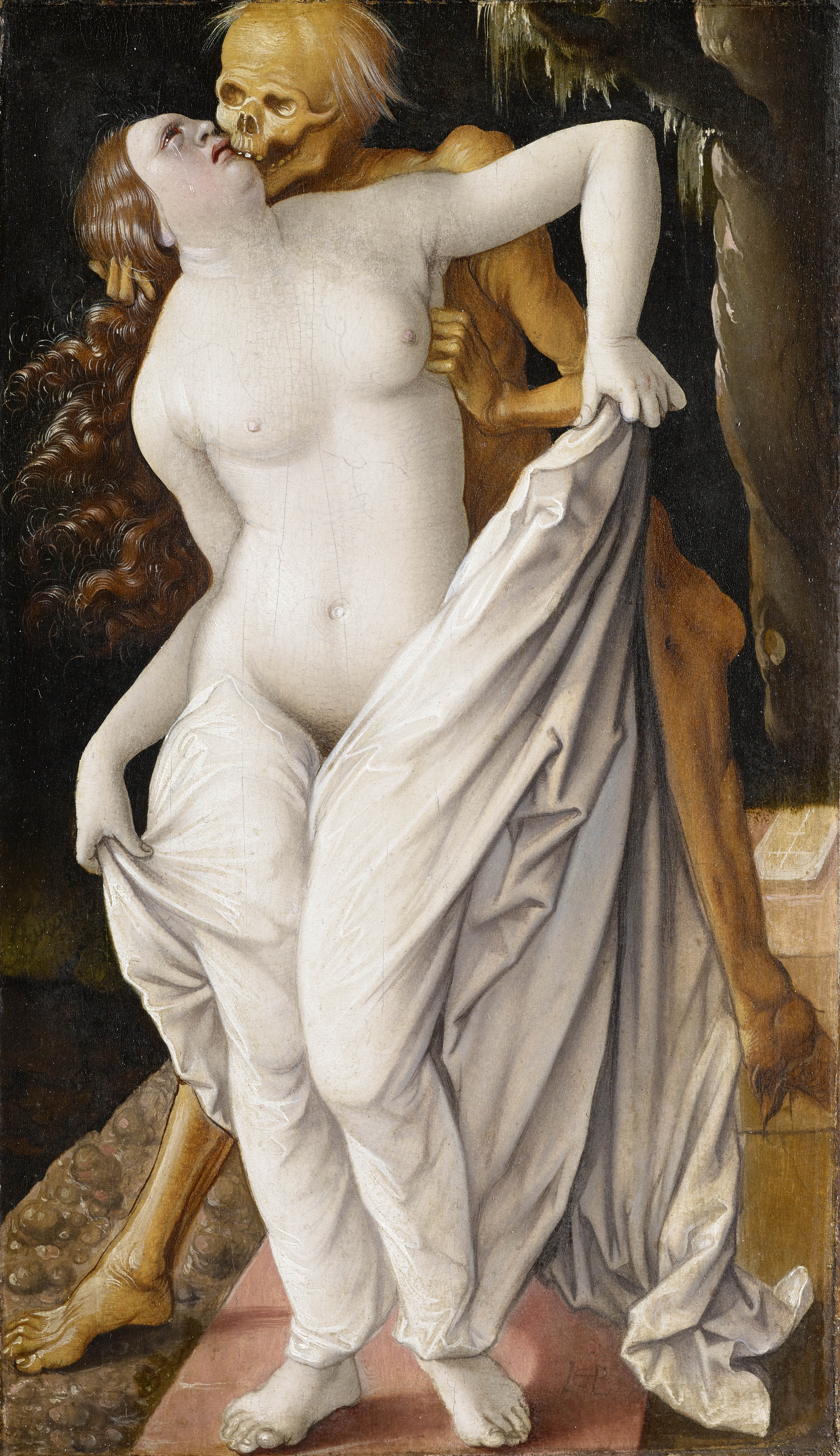
On the first page, the Countess is described as being "both death and the maiden". As well as being a play and a quartet, death and the maiden may link more closely to the oil painting of the same name by Hans Baldung:
This immediately sets up the gothic oppositions of life and death - the Countess is both alive and dead, young and old, beautiful and horrendous, at the same time. She is the predator and the prey. Being "both death and the maiden" is also a nice use of gothic antithesis. If you haven't noticed it already, look at the painting and laugh at how much the 'maiden' looks like Timothy Spall. That kept me entertained for ages.

One of the ways in which the Countess adheres to the typical elements of a gothic protagonist is her apparent fascination with the past. Carter calls her actions "her ancestral crimes", and notes that she wears "an antique bridal gown". As well as offering the idea of a fascination with the past, the mention of marriage is also liminal. In fact, ceremonies such as marriage are the first places whereby the word 'liminal' was actually used; when one is getting married, they are in the liminal stage between who they were when they were unmarried and who they will be when they are married.

Furthermore, the notion of a strange woman living alone in an old house wearing "an antique bridal gown" lends to the gothic elements of Great Expectations, and in particular the mysterious character of Miss Havisham. Below are three quotations from Great Expectations with similar quotations from this story to enforce this particular kind of intertextuality:

Great Expectations: "no glimpse of daylight was to be seen in it"
LotHoL: "closely barred shutters ... keep out every leak of natural light"

Great Expectations: "satins, and lace, and silks"
LotHoL: "hung with black satin", "burgundy velvet", "red plush cloth"

Great Expectations: "bridal flowers in her hair"
LotHoL: "antique bridal gown"

Furthermore, time doesn't move on for either character. The links between the two appear to be more than coincidental.

Also, this story has elements of Sleeping Beauty within it, demonstrating once again how Carter takes influence from fairy tales and extracts the "latent content" (as she puts it) from them in order to fuse them with the gothic genre. Both Sleeping Beauty and the Countess need some kind of release and are 'trapped' in their particular situations. To be more specific, both characters are released with a kiss - it releases Sleeping Beauty from her entrapment and it releases the Countess from life. If this wasn't enough for you, Carter later says that "a single kiss woke up the Sleeping Beauty in the Wood."

There are also intertextual references to Jack and the Beanstalk: "Fee fie fo fum / I smell the blood of an Englishman." This contrasts the allusions made to Sleeping Beauty - the Countess is not just a trembling victim, she is also a monstrous predator. She is both the protagonist and the antagonist - this links back to the quotation about the Countess being "both death and the maiden".

The characterisation of the Countess is particularly interesting and is great for both AO2 and AO3, because there is rich language to suggest that she is innocent and helpless (the maiden) as well as animalistic and fearsome. The fact is that she is both - which isn't a total surprise in gothic literature. She is the victim and the vixen, the predator and the prey.

The simile "her hair falls down like tears" presents the Countess as the typical trembling victim archetype of gothic women, as does the fact that during the day she can be heard "sobbing in a derelict bedroom." Later, Carter makes reference to her "finely veined, nervously fluttering eyelids", which enforces the language used to make her seem passive and helpless. Later, she is described as "a girl with the fragility of the skeleton of a moth" and as being "so delicate and damned".

However, amongst this Carter manages to bring in animalistic and monstrous imagery to make the Countess seem like a hideous beast. In a quotation that links almost directly to the wolf in The Company of Wolves, it is noted that "her claws and teeth have been sharpened" and that she also has "taloned hands". Furthermore, just like a wolf, it is said that "the Countess will sniff the air and howl." She is described as being "all claws and teeth" and is described as being "like a fox".

Carter also uses language to link the Countess to the supernatural and to highlight the conflicting nature of her character. She is described as "a closed circuit", which highlights her self entrapment, and it is said that "she is so beautiful she is unnatural; her beauty is an abnormality". Here Carter is tackling extremes head-on - the Countess is not just beautiful, she is so beautiful it's horrendous. This could be seen as a subversion of the typical beauty that is present in many fairy tales, particularly Sleeping Beauty. It is asked "How can she bear the pain of becoming human?" which of course highlights the human/monster dynamic that is common of the collection, and links to gothic extremes, liminality and metamorphosis. The use of a rhetorical question may also reflect how Carter is questioning boundaries. Another use of gothic antithesis refers to the Countess as a "beautiful and ghastly lady."

The Countess also keeps birds trapped in her house with her, similar to what the Erl-King does in the story of the same name. She asks the question, "'Can a bird sing only the song it knows or can it learn a new song?'" This question is repeated twice in the story, and appears to be indicative of the Countess's situation; will she only live the life she knows how to live, or will she ever break free of it? Furthermore, it is said that she "likes to hear it announce how it cannot escape." This presents her as a typical femme fatale-esque character: malicious, heartless and cruel. She can't escape from her situation, so why should anything else?

The fact that the story has a fixed setting in time is also interesting, because many of Carter's stories in this collection appear time-free or time-ambiguous (which is genuinely a phrase I just made up, don't use it). Carter modernises the gothic genre by placing her story in Eastern Europe during the First World War. By violating the fairy tale genre and placing it in a time period associated with war and death, she is sure to draw out the dark side to otherwise pleasant tales. Carter also takes the gothic genre and places it in a time of modern horror; we know that although the bicyclist survives this story, he probably won't survive for very long.

In this story, there is no young female virgin who becomes the victim of the male predator. Instead, Carter subverts gender roles in both fairy tales and gothic literature by making the predator female and having a male virgin appear on the scene. The young bicyclist appears to represent reason and rides on a bicycle which Carter refers to as "the product of pure reason applied to motion" and a "two-wheeled symbol of rationality". It is the soldier's rational nature that stops him from fearing the supernatural qualities of the Countess. He is a young man on the eve of war, and he is the 'prince charming' who releases her from her self-loathing state. It is as though the bicyclist is bringing the 20th Century to the Countess, who is referred to as "the timeless Gothic eternity of the vampires, for whom all is as it has always been and will be, whose cards always fall in the same pattern." The soldier brings her out of this timeless state - just another example of how Carter is bringing the gothic genre forwards into the modern world.

Through the soldier's eyes, we really do see everything rationally. He observes the Countess as "a great, ingenious piece of clockwork".

Furthermore, Carter pays particular attention to virginity again (surprise, surprise) by stating that the soldier "has the special quality of virginity". His virginity is also referred to as a "pentacle", a word which is also used to describe the girl's virginity in The Company of Wolves; once again it suggests a mystical power to the liminal state of virginity. And like the protagonist in The Company of Wolves, the soldier is logical and not afraid of the supernatural. The line "laughing, he sets out on his adventure" links to the moment in The Company of Wolves where the girl laughs in the wolf's face.

An interesting thing to consider regarding the soldier is whether he is presented as a masculine hero or a feminine character. He is described as "blond" and "blue-eyed", which are used to describe both typically heroic men and typically passive women. He is also associated with virginity, which in this collection is often more associated with woman. Yet he is also rational and logical, which is typically (unfairly, yes, but typically) associated with masculinity.

As the soldier walks towards the Countess's house, Carter uses overbearing sensory description which links the Countess to the Marquis in The Bloody Chamber: "A great, intoxicated surge of the heavy scent of roses blew into his face", "Too many roses...". Flowers are mentioned throughout the story, and at one point Carter talks of the Countess's "red lips like the obese roses". Roses are also what have "grown up into a huge, spiked wall" around the Countess's castle, and appears to be what traps her inside. Roses are usually symbols of love and/or beauty, yet here Carter violates that symbol, just as the Countess's beauty is violated into a "deformity".

When the soldier enters the house, we learn a little more about the setting and we are made aware of how gothic it is. The soldier sees his bicycle disappear into "the dark entrails of the mansion"; by using such language, which links to dismemberment, the place is given a horrific and gory feel, as though the Countess will prey upon him as she does the other men. Carter also notes the "lightless, cavernous interior of the place" and refers to it as "dismal" and "ruinous". It is also noted how "the painted eyes of family portraits briefly flickered as they passed", a typical gothic trope also used in The Bloody Chamber to suggest that in gothic literature the protagonist is always being watched, as though he/she cannot possibly escape. The Countess is also referred to as part of the setting: "she herself is a haunted house." This links to how the Erl-King is both the antagonist and the setting - another example of blurring boundaries.

In the bedroom, Carter once again uses role reversal when the bicyclist kisses the Countess's wound "as her mother ... would have done". This can be linked to the role reversal in The Erl-King, where the protagonist is referred to as "mother" once she has killed the titular character.

Before she dies, after being released into death by the soldier's kiss, Carter changes tense and we hear the Countess's perspective: "the dark, fanged rose I plucked from between my thighs". Once again rose imagery is violated and even 'fanged' as though it is as vampiric as the Countess herself.

The rational bicyclist appears to 'triumph' in the story, although really the Countess was never a true predator because she was a victim of her own nature. Rationality beats the supernatural, and "the boy in the fairy tale" aims to "turn her into the lovely girl she is; I will cure her of all these nightmares."

So it seems the heroic soldier has a somewhat happy ending. He releases the Countess from the tortures of life and the final line is "next day, his regiment embarked for France." But really this isn't a happy ending at all, as the young man is about to face an even greater horror that is simply part of our history - the Great War. Is Carter suggesting that, no matter how horrific vampires and spooky houses may be, nothing in gothic literature can live up to the insurmountable horror of war?

Monday, 27 May 2013

A2 English Literature: Frankenstein Example Essay (Monstrosity)

Another one mainly for the people on TSR - this is an essay I did back before Christmas on Frankenstein. It received a middle band 6 mark (I wasn't told what mark exactly, just that it was mid-band 6) and wasn't done in timed conditions:

To what extent do you agree with the view that the humans in Frankenstein are more monstrous than the ‘monster’?


Mary Shelley’s ‘monster’, presented through the eyes of Victor Frankenstein as a “miserable wretch”, is arguably not as monstrous as the presentation of humans in the novel. The word ‘monster’ itself has Latin roots, referring to the verb to ‘demonstrate’ or ‘warn’. In this respect, the creature may stand as a warning outside of humanity following Victor’s monstrous act of assembling the creature from human corpses. The journey the creature embarks sees influences through art, culture and literature, and while the creature may initially appear monstrous, it is fair to deduce that the cruelty and barbarity of humans within the novel present them as more monstrous than the ‘monster’ first appears to be.
From his conception, the creature comes across many humans who act barbarously towards him, but none more so than Victor, his creator. Victor’s initial idea for such an experiment can be viewed as monstrous in itself; the act of taking body parts from the dead in order to assemble a brand new creature is from the outset a horrific and very Gothic image, as well as an example of a Gothic protagonist going to extreme lengths to achieve a certain goal or aim. However, it is Victor’s rejection of his own creation that presents him as such a monstrous character. Upon seeing the creature, animated for the first time, Victor notes that “a breathless horror and disgust filled my heart”. It is interesting to note that Victor’s disgust comes purely from the physical appearance of the creature. Shelley juxtaposes a sense of ugliness and beauty in the form of the creature; while it possesses a “shrivelled complexion”, Victor still notes “lustrous black” hair and “teeth of a pearly whiteness”. Victor’s conflicted use of language may suggest that the creature is physically repellent as a liminal stage not only between life and death, but between beauty and monstrosity. It is possible to view Victor’s rejection of his creature as being a comment made upon society by Mary Shelley; the creature is beaten, fled from and rejected simply for what it looks like. In life, this is often the case for those who are presented as physical outsiders, something which Shelley may be criticising.
Developing the potential critique on society, it is interesting to view the ‘humanity’ of the creature in the novel. Despite being initially violent and clumsy, the creature picks up certain aspects of culture and the arts in order to fashion himself into a character who is far more human than first suspected. As the creature recounts his tale in the embedded narrative, the story of his discovery of fire is told. He ponders the contrasts of the warmth and pain that the fire offers: “how strange, I thought, that the same cause should produce such opposite effects!” This may be interpreted as a ‘rediscovery’ of fire and it is arguable that the creature is similarly presented as a new version of humanity, presenting him as more uniquely human as opposed to the barbarity of humans in the novel. The fire may also represent the myth of Prometheus, especially considering the novel was originally referred to as ‘The Modern Prometheus’. The myth tells the story of Prometheus, a Titan who steals fire from the Gods in order to create life. Despite this sounding as if humanity is presented as God-like, the character of Prometheus has been famed for his cunning intelligence and is punished cruelly by the Gods, just as the creature is punished and preyed upon by humanity throughout the novel. It is also interesting to note that in Western classical tradition, Prometheus is often viewed as representative of a desperate quest for knowledge. Although this could also be applied to the efforts of Victor Frankenstein to further his scientific knowledge beyond the realms of apparent possibility, the character of Prometheus may also be relevant to the creature, considering the thirst for knowledge he has throughout his journeys in the novel.
The knowledge the creatures strives and acquires throughout the novel may also suggest that he is more virtuous and humane than any of the humans in the story. Upon observing the lives of the De Lacey family, the creature begins to acquire a thirst for literature, which leads to his interest in texts such as Milton’s ‘Paradise Lost’, to which he notes “I often referred the situations (…) to my own…” This adds further weight to the interpretation that the creature is viewed as a new and innocent being who is subject to the evils and torment of the world around him. Similarly, after reading Volney’s ‘Ruins of Empires’, the creature ponders how humanity is “at once so powerful, so virtuous and magnificent, yet so vicious and base?” The creature’s interest in literature suggests there is a cultured element to his character, and the questions that arise from what he reads presents the humans around him as “vicious”, which reinforces the notion that the humans in the novel are more monstrous than the creature appears to be. The matter of the creature being ‘virtuous’ ties in with the philosophical ideas that William Godwin spoke of. As Shelley’s father, it is possible that Godwin’s work had some influence on her own; Godwin referred to “universal benevolence”, and suggested that humanity was inherently benevolent, yet corrupted by government and its effects upon society. This suggests that the creature is presented as a virtuous and innocent creature, new into the corrupted world in which the monstrous humans are living in. Before the initial creation, Victor even refers to his creation as pouring “a torrent of light into this dark world”. The Gothic oppositions of light and dark often refer to rationality and irrationality respectively, which may suggest that the creature is representative of rationality and knowledge in an otherwise corrupt and clouded world. Furthermore, the creature says of knowledge “of what a strange nature is knowledge! It clings to the mind, when it has once seized on it, like a lichen on the rock”. Shelley’s use of simile here shows the strength of which knowledge imprints itself on the creature’s character; his inspired reaction to literature suggests he is more cultured than any of the humans in the novel.
However, it is fair to argue conversely that Victor is also greatly affected by texts, and refers to Agrippa, Magnus and Paracelsus as “the lords of my imagination”. Victor’s passion for the issues surrounding the works he reads is what leads to his creation of the ‘monster’. It is arguable to deduce that Victor’s treatment of his own creation is what leads to the creature being branded as a ‘monster’ to some extent; the creature is born alone and confused into an alien world, and shunned by his own creator. To an extent, the reader may be able to forgive some of the creature’s monstrous acts (such as killing William) due to the fact that the creature has both little understanding of the world and a desire to be treated fairly by the man who created him. The fact that both Victor and the creature show such devotion to texts and literature may suggest an element of Gothic doubling between the two, as if they are two sides of one ‘being’. When looking for the creature, Victor states that he sees his creation as “nearly in the light of my own vampire, my own spirit let loose from the grave”. The Gothic language alone suggests that there is an irrational element to Victor, and it is arguable that the creature represents the more rational and perhaps even more human side to Frankenstein’s persona, whereas Victor is portrayed as the monstrous character; the nature of the quote could also suggest that Victor is referring to himself when he speaks of a “depraved wretch”, which furthers the interpretation that he and the creature are more alike than first thought. The language used by both Victor and the creature also suggests a sense of duality between them; in chapter ten, Victor’s language appears extreme and melodramatic, whereas the creature’s language seems composed and collected. Victor states “the tortures of hell are too mild a vengeance for thy crimes. Wretched devil!” and threatens the creature with “the fierce vengeance of my arm wreaked on your miserable head”. Victor’s extreme and inflammatory language, speaking of ‘hell’ and ‘vengeance’, may present him as something of a vengeful God, who appears enraged at his own creation. This links to the notion of the creature being an ‘updated’ version of humanity akin to Adam and Eve’s story in ‘Paradise Lost’, victim to an angry God who has brought the creation into a corrupt and monstrous world. The creature’s language, in contrast, is eloquently phrased and constructed: “Everywhere I see bliss from which I alone am irrevocably excluded”. Shelley’s use of contrasting language between the creature and Victor strongly suggests that Victor is far more vengeful and ‘monstrous’ than the creature.
In conclusion, the humans in Frankenstein definitely appear more monstrous than the creature. Despite the creature’s initial monstrous acts, and his connections to animalism and the wilderness due to his association with sublime settings, it must be noted that he is a brand new creature in the world, and shunned by the only man who can answer his questions. As the creature grows from an incoherent beast into a cultured being who respects literature and the arts, he appears to rise above the humans in the novel. Victor’s language and the act of his creation present him as a monstrous being in the novel, and as one interpretation suggests as a vengeful God who has unfairly bestowed the innocent creature upon a world populated by unforgiving and in many cases barbaric creatures, who monstrously exclude the creature from society for what he looks like, as opposed to who he is.

A2 English Literature: The Company of Wolves

The Company of Wolves opens with the story of a hunter who tries to kill a wolf that has been terrorising his local town, and then the story of a man who is presumed killed by a wolf and later returns to his family, turning back into the wolf when he sees that his wife has remarried.

The main body of the story, however, starts with a "strong-minded child" who aims to take "delicious gifts to a reclusive grandmother"; the parallels with Little Red Riding Hood are obvious and yet another example of how Carter aims to extract the "latent content" from typical fairy tales.

Carter pays special attention to the fact that the girl is a virgin. She refers to her virginity as an "invisible pentacle"; this mystical imagery suggests an element of inexplicable power surrounding her virginity - her virginity is both liminal and cannot be explained, two prominent features of gothic literature. This also continues Carter's recurring motif of virginity. The narrator in The Bloody Chamber is a virgin, as are the characters in The Courtship of Mr Lyon, The Tiger's Bride and The Erl-King to name a few. Furthermore, in The Lady of the House of Love, the young bicyclist's virginity is also referred to as a "pentacle" - so perhaps it is not female virginity that Carter is highlighting, but virginity itself.

The girl's virginity in this story appears to keep her strong as she walks through the wolf-ridden forest: "she is a closed system; she does not know how to shiver. She has her knife and she is afraid of nothing." There's no doubt at this point that the girl is presented as a strong character. The same cannot be said for the girl in The Bloody Chamber, however. Furthermore, it is said that the girl "knew she was nobody's meat." This directly contrasts with the treatment of the girl in The Bloody Chamber, who is inspected as "cuts on a slab."

I'm not going to go through the story moment by moment and focus on AO2 with The Company of Wolves, because I think it is more important to tackle the AO3 aspects of this story. The story ends with the girl meeting with the wolf who has devoured her grandmother. She removes her clothes and willingly loses her virginity to the wolf - and this appears to be what empowers her. By submitting sexually to the wolf, her life is spared.

This can be argued either way - some will argue that by doing this the ending is feminist and liberating. Others will argue that this belittles the girl's strength and reduces her to nothing more than an object. Perhaps Carter is likening the naked male form to terrifying beasts that prey on the innocent. Are men to be feared and submitted to?

Alternatively, it is possible to argue that Carter is saying that sexuality shouldn't be feared, but embraced. The other characters who become victims of the wolf also seem to be 'victims' of some kind of oppression:

  • The woman in the first tale is attacked by the wolf whilst straining macaroni - perhaps she is attacked because she is oppressed by her role as a passive, domesticated woman (an archetype that fits with the gothic and fairy tale genres)
  • The hermit who is killed by the wolf appears to be oppressed by his servility to God - is the wolf a symbol of freedom or self-realisation, attacking those who are not able to free themselves?
  • The woman who remarries an abusive man is beaten by her husband after he kills a wolf (symbolic of the oppressive man killing the woman's hope at freedom, perhaps). She is servile to her husband
  • The girl's grandmother is servile to God and to domesticity - when the girl enters her grandmother's house, it is interesting to note how Carter pays attention to the fact that "the Bible lay closed on the table"
Yet the girl is not tied down by domesticity, femininity or religion; she is her own person and she makes her own decisions. She even laughs in the face of the wolf as she undresses herself. She is the only character in the story who adapts to the situation in order to survive; she becomes a woman at the hands of the wolf and this arguably reverses the predator/prey dynamic that is so often prevalent in fairy tales. Carter reinvents the fairy tale genre by giving the young child the power to overcome the beast.

One interpretation is that the wolf is a symbol of something that we are all greeted with in life; the chance to realise our own freedom and break free of any restricting forces. Some take the opportunity while others do not. Alternatively, the wolf may be a symbol of humanity's carnal desires (this certainly links to The Tiger's Bride where the titular character becomes a beast by embracing her desires). Therefore the argument that the girl is a strong character seems to have more weight than the argument suggesting that she objectifies herself by using her virginity to survive. 

Sunday, 26 May 2013

A2 English Literature: The Bloody Chamber Example Essay

Below is an essay on happy-ever-after endings in The Bloody Chamber (a question made up by my teacher and not taken from any past papers). I know some of the guys on TSR in particular were interested in examples of band 6 essays; whether you can take anything from this or not I'm not sure, but I thought I'd put it here in case it helps anyone! This essay received full marks:

Carter's stories have happy ever after endings, although these endings are somewhat unconventional. To what extent are the endings feminist in their message?

As a feminist, it is almost to be expected that many of Angela Carter’s happy ever after endings will strike the reader with a bold feminist message. However, in The Bloody Chamber, this is not necessarily the case. Although there are several feminist messages in the stories’ resolutions, these messages are not always presented in the way one would expect, and not every female protagonist is presented as a feminist character. By taking the roles of typically Gothic women and toying with the presentation of female characters, many of Carter’s feminist messages are not as one would expect.
        The eponymous story The Bloody Chamber ends with a sense of resolution, love and happiness. The antagonist of the story is no more, and the narrator is able to live a happy and fulfilling life with Jean-Yves. Whether the ending is truly feminist, however, is open to discussion. In one respect, the actual resolution to the story is all down to the narrator’s mother, who is presented at the story’s climax as an incredibly powerful female figure. Carter uses masculine and bestial imagery to describe the mother, in a way that is not dissimilar to earlier imagery to describe the Marquis. The narrator refers to her mother’s hair as “her white mane”; just as earlier she had referenced the Marquis’s “dark mane”. The juxtaposition between light and dark here is a typical example of Gothic extremes; while the Marquis seems to represent darkness – the supernatural and evil – the mother is associated with the colour white, which often symbolises purity, innocence and rationality. She also refers to her mother as a “wild thing”. Carter also uses the setting to complement the powerful image of the narrator’s mother riding to her rescue. The backdrop of the sea is referred to as “savage”, like “the witnesses of a furious justice”. In Gothic literature it is common for great expanses of nature such as oceans or moors to be referred to in the sublime sense; in this instance, the great power of the sea is merely witnessing the justice that the mother is delivering. It is as though her power is greater than nature itself. Furthermore, the sea is used earlier in the story when the narrator describes the Marquis’s voice as “like the soft consolations of the sea”. It appears as though the male and female dynamics have been shifted with these two direct links to the sea; the Marquis is the one associated with softness and docility whereas the mother seems to be the one commanding the sea and bringing about its true power. In this respect, she is certainly a strong female figure who arguably brings about a feminist happy ever after to the story.
However, the strength of the mother is not the be-all and end-all of the story. Firstly, it is interesting to note that particular attention is paid to the fact that the mother holds the narrator’s “father’s service revolver”. The male figure is therefore not necessarily as absent as one might think; the actual tool that is intended to kill the Marquis is explicitly referred to as the item of a man. Furthermore, it is important to note that the narrator does very little to secure her own safety, and the main resolution of the story is placed in the mother’s hands. The narrator is presented as a very passive character in the denouement of the tale; she is simply saved by her mother and is then able to live out her life in happiness. In this respect it is arguable to suggest that she is not a strong female character or, at least, she is not as strong as the reader may have hoped. Carter also highlights the contrasts between the narrator and her mother. The narrator notes that “on her eighteenth birthday, my mother had disposed of a man-eating tiger”, and juxtaposes this with “here I was, scarcely a penny richer, widowed at seventeen in the most dubious circumstances”. In this respect, the ending is not particularly feminist at all; although the narrator has been saved and is given a happy ending, her role in the climax of the story appears to be similar to that of a typically passive Gothic female character. She is also physically tarnished by the events of her past, noting that “no paint or powder (…) can mask that red mark on my forehead”. Despite the resolution and the fiercely powerful actions of the mother, the narrator is still objectified even after the Marquis’s death; she is branded with his mark, as though she was never really a woman in her own right.
The ending of The Company of Wolves, however, is arguably the story with the strongest feminist message. The girl survives her ordeal with the wolf by embracing the power of her own sexuality, which in turn saves her life and reverses the predator/prey dynamic of herself and the wolf. Even when allowed into the forest where countless others have been killed, the girl “has her knife and she is afraid of nothing”. When the girl arrives at the house of the wolf at the end of the story, she reacts in a way that none of the other victims have acted. She is defiant in her actions and even mocks the wolf; “the girl burst out laughing; she knew she was nobody’s meat”. The fact that the girl does not fear the monstrous and supernatural beast before her is just one reason why the ending of the story is overtly feminist.
       Unlike those before her, the girl is free and liberated thanks to her own sexual awareness. Carter pays special attention to her virginity, and uses mystical imagery such as referring to it as a “pentacle” and a “magic space” to attach a sense of power to it. Unlike the wolf’s previous victims, the girl embraces freedom and liberation. The typically Gothic servile woman who is killed by the wolf is arguably killed because of her position as a stereotypical female; this interpretation is enforced by the fact that she is killed whilst straining macaroni in a typically domestic setting. The hermit is arguably killed because of his servile nature to God, and the grandmother is also servile to both religion and the domestic setting that she appears bound to. The girl, however, is servile to nothing and nobody. Her virginity is not a weakness in the end, but a weapon. When she embraces it, she seems to take on a role that is stronger than the wolf. Carter notes how just the sight of her makes the wolf “slaver”, and she also actively undresses the wolf as well as herself. It is arguable to suggest that the way in which the girl liberates herself is demeaning, however she does not obey the wolf’s orders out of fear or duty; it is as though Carter is saying that sexuality should not be feared, but embraced. The very last line of the story calls the wolf “tender”, and shows the girl sleeping in the bed with the wolf. She is the only one to have survived the wolf, and has done this through allowing him to liberate her – something that the previous victims were unable to do. In this respect, the happy ever after ending to this story presents a strong feminist message.

        In conclusion, Carter’s stories often have an element of a feminist message to them, whether this is the mother being presented as the heroine in The Bloody Chamber, the girl embracing her sexuality and the power alongside it in The Company of Wolves, or other similar instances of females either being able to bring out the humanity of beasts through compassion, such as in The Courtship of Mr Lyon, or embracing their own primal nature, such as in The Tiger’s Bride. However, that is not to say that all of Carter’s stories have a feminist ending. The main character of The Bloody Chamber seems passive in the story’s ending and the mark that stays upon her forehead does not allow for a true sense of catharsis at the end of the story. Carter’s stories are never black and white; there are feminist qualities to many of the happy ever after endings, but not necessarily in the way one would expect.